CITB HS&E test (operatives) · CSCS card
CSCS test practice for the CITB HS&E test
In English, with Romanian or Polish help if you want it. 50-question mocks, 45 to pass.
iPhone app coming soon. Until then, practise free on this site.
Last updated: · Certloom Learning
Made by Certloom Learning. The questions are original, written from UK law and HSE guidance with AI help and a separate AI check of answers and translations; they are not the official test questions and are not reviewed by CITB, CSCS or HSE.
- 50questions in the real test
- 45 minto answer them
- 45 of 50to pass (90%)
- £23.50CITB test fee
From the CITB and CSCS pages, checked 2026-11-15: CITB.
What does the app look like?
Real screens from the Android app. Tap a screen to see it bigger.
How does SiteSide work?
- Read the question in English, exactly as you would on test day.
- Check every word in Romanian or Polish underneath, including all four answers.
- Answer, then read why the right answer is right in both languages.
- Switch on Test-day English to hide the help. Hold to peek when you are stuck.
Can I try it free? One question from each topic
Choose an answer to see the explanation. These are original practice questions, not the official test questions.
Under the Health and Safety at Work etc. Act 1974, what is an employer's general duty to employees?
Conform Health and Safety at Work etc. Act 1974, care este obligația generală a angajatorului față de angajați?
- Să se asigure că niciunul dintre ei nu poate păți vreodată vreun accident la locul de muncă
- Să-i protejeze doar cât timp folosesc echipamentul propriu al firmei
- Să le protejeze sănătatea, securitatea și bunăstarea, în măsura în care este rezonabil posibil
- Să le dea sfaturi de siguranță și să lase măsurile de protecție în seama lor
Jaki jest, zgodnie z Health and Safety at Work etc. Act 1974, ogólny obowiązek pracodawcy wobec pracowników?
- Zapewnić, żeby żadnemu z nich nigdy nie mógł się przytrafić żaden wypadek podczas pracy
- Chronić ich tylko wtedy, gdy używają sprzętu należącego do firmy
- Chronić ich zdrowie, bezpieczeństwo i dobrostan w zakresie, w jakim jest to racjonalnie wykonalne
- Udzielić im porad dotyczących bezpieczeństwa, a środki ostrożności zostawić im samym
Section 2 of the Health and Safety at Work etc. Act 1974 says employers must ensure, so far as is reasonably practicable, the health, safety and welfare at work of all their employees. The law does not demand that no accident can ever happen. It demands sensible precautions that match the risk, for all work, not only work with company equipment.
Secțiunea 2 din Health and Safety at Work etc. Act 1974 (Legea privind sănătatea și securitatea în muncă) spune că angajatorii trebuie să asigure, în măsura în care este rezonabil posibil, sănătatea, securitatea și bunăstarea la locul de muncă pentru toți angajații lor. Legea nu cere ca niciun accident să nu se poată întâmpla vreodată. Cere măsuri de protecție rezonabile, pe măsura riscului, pentru toată munca, nu doar pentru munca cu echipamentul firmei.
Sekcja 2 Health and Safety at Work etc. Act 1974 (Ustawa o bezpieczeństwie i higienie pracy) mówi, że pracodawcy muszą zapewnić, w zakresie, w jakim jest to racjonalnie wykonalne, zdrowie, bezpieczeństwo i dobrostan w pracy wszystkich swoich pracowników. Prawo nie wymaga, żeby nigdy nie mógł zdarzyć się żaden wypadek. Wymaga rozsądnych środków ostrożności dopasowanych do ryzyka, przy każdej pracy, a nie tylko przy pracy ze sprzętem firmy.
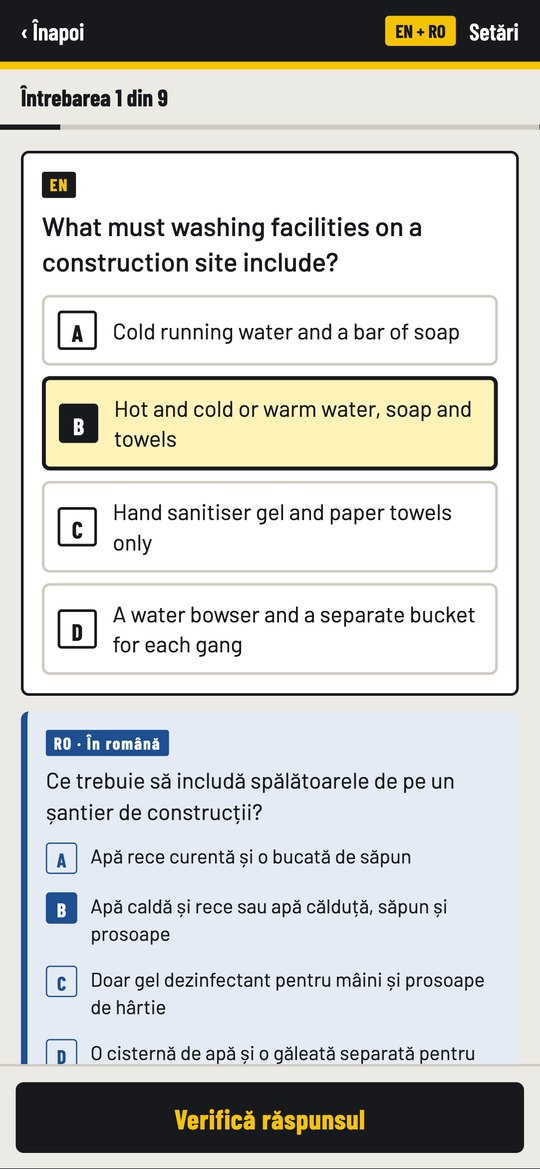
What must washing facilities on a construction site include?
Ce trebuie să includă spălătoarele de pe un șantier de construcții?
- Apă rece curentă și o bucată de săpun
- Apă caldă și rece sau apă călduță, săpun și prosoape
- Doar gel dezinfectant pentru mâini și prosoape de hârtie
- O cisternă de apă și o găleată separată pentru fiecare echipă
W co muszą być wyposażone umywalnie na budowie?
- Zimna bieżąca woda i kostka mydła
- Gorąca i zimna albo ciepła woda, mydło i ręczniki
- Tylko żel do dezynfekcji rąk i ręczniki papierowe
- Beczkowóz z wodą i osobne wiadro dla każdej brygady
Schedule 2 of the Construction (Design and Management) Regulations 2015 says washing facilities must have clean hot and cold, or warm, water, soap or another way of cleaning, and towels or another way of drying. Cold water and soap alone is not enough and does not remove cement, oil and dirt well. If something is missing, tell your supervisor.
Anexa 2 din Construction (Design and Management) Regulations 2015 (Regulamentul privind proiectarea și managementul în construcții) spune că spălătoarele trebuie să aibă apă curată caldă și rece, sau apă călduță, săpun sau alt mijloc de curățare, și prosoape sau alt mijloc de uscare. Doar apă rece și săpun nu este suficient și nu îndepărtează bine cimentul, uleiul și murdăria. Dacă lipsește ceva, spune-i supervizorului.
Załącznik 2 (Schedule 2) do Construction (Design and Management) Regulations 2015 (Przepisy o projektowaniu i zarządzaniu w budownictwie) mówi, że umywalnie muszą mieć czystą gorącą i zimną albo ciepłą wodę, mydło lub inny środek do mycia oraz ręczniki lub inny sposób osuszania rąk. Sama zimna woda z mydłem nie wystarczy i słabo usuwa cement, olej i brud. Jeśli czegoś brakuje, powiedz przełożonemu.
Source: The Construction (Design and Management) Regulations 2015, Schedule 2
What are the COSHH Regulations 2002 mainly about?
Despre ce este, în principal, COSHH Regulations 2002?
- Planificarea lucrului în siguranță pe schele
- Raportarea accidentelor și a incidentelor evitate la limită către HSE
- Controlul substanțelor care pot afecta sănătatea
- Controlul zgomotului produs de mașini și scule
Czego głównie dotyczą COSHH Regulations 2002?
- Planowania bezpiecznej pracy na rusztowaniach
- Zgłaszania wypadków i zdarzeń potencjalnie wypadkowych do HSE
- Kontroli substancji, które mogą szkodzić zdrowiu
- Kontroli hałasu maszyn i narzędzi
The Control of Substances Hazardous to Health Regulations 2002 (COSHH) require employers to prevent or control exposure to substances that can harm health, such as chemicals, dust and fumes. Noise is covered by a different law, the Control of Noise at Work Regulations 2005. Ask your supervisor if you are unsure which rules apply to a task.
Control of Substances Hazardous to Health Regulations 2002 (COSHH) (Regulamentul privind controlul substanțelor periculoase pentru sănătate) obligă angajatorii să prevină sau să controleze expunerea la substanțe care pot afecta sănătatea, cum ar fi chimicalele, praful și fumul. Zgomotul este acoperit de o altă lege, Control of Noise at Work Regulations 2005 (Regulamentul privind controlul zgomotului la locul de muncă). Întreabă-ți supervizorul dacă nu ești sigur ce reguli se aplică unei lucrări.
Control of Substances Hazardous to Health Regulations 2002 (COSHH) (Przepisy o kontroli substancji niebezpiecznych dla zdrowia) wymagają od pracodawców, aby zapobiegali narażeniu na substancje, które mogą szkodzić zdrowiu, takie jak chemikalia, pyły i opary, albo kontrolowali to narażenie. Hałas reguluje inne prawo, Control of Noise at Work Regulations 2005 (Przepisy o kontroli hałasu w pracy). Jeśli nie masz pewności, które przepisy dotyczą danej pracy, zapytaj przełożonego.
Source: The Control of Substances Hazardous to Health Regulations 2002, HSE: COSHH
Under the Control of Noise at Work Regulations 2005, what is the lower exposure action value for daily noise exposure?
Conform Control of Noise at Work Regulations 2005, care este valoarea de expunere inferioară de declanșare a acțiunii pentru expunerea zilnică la zgomot?
- 85 dB(A)
- 87 dB(A)
- 80 dB(A)
- 75 dB(A) pe parcursul unei zile de lucru
Jaka jest, według Control of Noise at Work Regulations 2005, dolna wartość progowa działania dla dziennego narażenia na hałas?
- 85 dB(A)
- 87 dB(A)
- 80 dB(A)
- 75 dB(A) w ciągu dnia pracy
The lower exposure action value in the Control of Noise at Work Regulations 2005 is a daily or weekly average exposure of 80 dB(A). At this level your employer must assess the risk, give information and training, and make hearing protection available. 85 dB(A) is the upper exposure action value, not the lower one.
Valoarea de expunere inferioară de declanșare a acțiunii din Control of Noise at Work Regulations 2005 (Regulamentul privind controlul zgomotului la locul de muncă) este o expunere medie zilnică sau săptămânală de 80 dB(A). La acest nivel, angajatorul tău trebuie să evalueze riscul, să ofere informații și instruire și să pună la dispoziție protecție auditivă. 85 dB(A) este valoarea de expunere superioară de declanșare a acțiunii, nu cea inferioară.
Dolna wartość progowa działania w Control of Noise at Work Regulations 2005 (Przepisy o kontroli hałasu w pracy) to średnie dzienne lub tygodniowe narażenie 80 dB(A). Przy tym poziomie pracodawca musi ocenić ryzyko, przekazać informacje i przeszkolić pracowników oraz udostępnić ochronniki słuchu. 85 dB(A) to górna wartość progowa działania, a nie dolna.
Source: Control of Noise at Work Regulations 2005, regulation 4, HSE: Noise at work
Under the Manual Handling Operations Regulations 1992, what should an employer try to do first about a risky manual handling task?
Conform Manual Handling Operations Regulations 1992, ce ar trebui să încerce angajatorul să facă mai întâi în cazul unei operațiuni de manipulare manuală riscante?
- Să-i instruiască pe muncitori să ridice mai corect
- Să evite nevoia de a o face
- Să dea centuri de susținere pentru spate
- Să pună un semn de avertizare
Co zgodnie z Manual Handling Operations Regulations 1992 pracodawca powinien najpierw spróbować zrobić z ryzykownym zadaniem przy ręcznych pracach transportowych?
- Przeszkolić pracowników, jak lepiej podnosić
- Uniknąć potrzeby jego wykonywania
- Rozdać pasy stabilizujące kręgosłup
- Wywiesić znak ostrzegawczy
The regulations set an order: first avoid hazardous manual handling so far as is reasonably practicable, then assess what cannot be avoided and reduce the risk. Training is useful, but it comes after looking at whether the task can be avoided, for example by using a machine or delivering materials closer to where they are used.
Manual Handling Operations Regulations 1992 (Regulamentul privind operațiunile de manipulare manuală) stabilește o ordine: mai întâi se evită manipularea manuală periculoasă, în măsura în care este rezonabil posibil, apoi se evaluează ce nu se poate evita și se reduce riscul. Instruirea este utilă, dar vine după ce s-a verificat dacă operațiunea poate fi evitată, de exemplu folosind un utilaj sau livrând materialele mai aproape de locul unde sunt folosite.
Przepisy ustalają kolejność: najpierw unikać niebezpiecznych ręcznych prac transportowych w zakresie, w jakim jest to racjonalnie wykonalne, potem ocenić te, których nie da się uniknąć, i ograniczyć ryzyko. Szkolenie jest przydatne, ale przychodzi dopiero po sprawdzeniu, czy zadania można uniknąć, na przykład używając maszyny albo dostarczając materiały bliżej miejsca, w którym są używane.
Source: Manual Handling Operations Regulations 1992, regulation 4, HSE: Manual handling at work
Which three things does a fire need to start and keep burning?
Care sunt cele trei lucruri de care are nevoie un incendiu ca să pornească și să continue să ardă?
- Combustibil, fum și vânt
- Căldură, dioxid de carbon și combustibil
- Oxigen, praf și vreme uscată
- Combustibil, oxigen și căldură
Jakie trzy rzeczy są potrzebne, żeby ogień powstał i dalej się palił?
- Paliwo, dym i wiatr
- Ciepło, dwutlenek węgla i paliwo
- Tlen, pył i sucha pogoda
- Paliwo, tlen i ciepło
A fire needs fuel, oxygen and heat to start and keep burning; this is called the fire triangle. Carbon dioxide does not feed a fire, it is used in some extinguishers to smother one. HSE guidance HSG168 uses the fire triangle to explain how fires on site can be prevented.
Un incendiu are nevoie de combustibil, oxigen și căldură ca să pornească și să continue să ardă; asta se numește triunghiul focului. Dioxidul de carbon nu alimentează focul; este folosit în unele stingătoare ca să-l înăbușe. Ghidul HSE HSG168 folosește triunghiul focului ca să explice cum pot fi prevenite incendiile pe șantier.
Do powstania i podtrzymania ognia potrzebne są paliwo, tlen i ciepło; nazywa się to trójkątem spalania. Dwutlenek węgla nie podsyca ognia, jest używany w niektórych gaśnicach do jego zdławienia. Wytyczne HSE HSG168 wykorzystują trójkąt spalania, aby wyjaśnić, jak można zapobiegać pożarom na budowie.
Under the Work at Height Regulations 2005, when does a task count as work at height?
Conform Work at Height Regulations 2005, când se consideră o sarcină drept lucru la înălțime?
- Doar când ești la mai mult de 2 metri deasupra solului
- Doar când lucrezi pe un acoperiș sau pe o schelă
- Când o cădere ar putea răni pe cineva, la orice înălțime
- Doar când ești deasupra nivelului solului, nu sub el
Kiedy, zgodnie z Work at Height Regulations 2005, zadanie liczy się jako praca na wysokości?
- Tylko wtedy, gdy jesteś wyżej niż 2 metry nad ziemią
- Tylko wtedy, gdy pracujesz na dachu lub na rusztowaniu
- Gdy upadek mógłby kogoś zranić, na dowolnej wysokości
- Tylko wtedy, gdy jesteś powyżej poziomu terenu, a nie poniżej
The Work at Height Regulations 2005 apply to any place where a person could fall a distance liable to cause injury. There is no minimum height, and it includes falling into an opening or excavation below ground level. The idea that the law only starts at 2 metres is a common myth.
Work at Height Regulations 2005 (Regulamentul privind lucrul la înălțime) se aplică oricărui loc de unde o persoană ar putea cădea de la o distanță care poate provoca o rănire. Nu există o înălțime minimă, iar asta include și căderea într-un gol sau într-o săpătură sub nivelul solului. Ideea că legea se aplică abia de la 2 metri este un mit des întâlnit.
Work at Height Regulations 2005 (Przepisy o pracy na wysokości) obejmują każde miejsce, z którego ktoś mógłby spaść z wysokości mogącej spowodować obrażenia. Nie ma minimalnej wysokości, a przepisy obejmują też wpadnięcie do otworu lub wykopu poniżej poziomu terenu. Przekonanie, że prawo zaczyna obowiązywać dopiero od 2 metrów, to częsty mit.
Source: The Work at Height Regulations 2005, regulation 2, HSE: Working at height - a brief guide (INDG401)
Under the CDM Regulations 2015, what must be done where needed to stop an excavation collapsing?
Conform CDM Regulations 2015, ce trebuie făcut, acolo unde este nevoie, pentru ca o săpătură să nu se surpe?
- Pereții se sprijină sau se taluzează
- Șanțul se ține mai puțin adânc decât până la talie
- Se sapă doar când vremea este uscată
- Se pun indicatoare de avertizare pe margini
Co, zgodnie z CDM Regulations 2015, trzeba zrobić tam, gdzie jest to potrzebne, żeby wykop się nie zawalił?
- Umocnić ściany albo ściąć je w skarpę
- Utrzymywać wykop płytszy niż do pasa
- Kopać tylko przy suchej pogodzie
- Postawić znaki ostrzegawcze wzdłuż krawędzi
The Construction (Design and Management) Regulations 2015 require practicable steps, including supports or battering where necessary, to stop an excavation collapsing. Keeping a trench shallow is not a safe rule, because even a shallow trench can collapse and bury someone. Signs warn people but do nothing to hold the sides up.
Construction (Design and Management) Regulations 2015 (Regulamentul privind proiectarea și managementul în construcții) cer măsuri practice, inclusiv sprijiniri sau taluzare acolo unde este nevoie, pentru ca o săpătură să nu se surpe. Să ții șanțul puțin adânc nu este o regulă sigură, pentru că și un șanț puțin adânc se poate surpa și poate îngropa un om. Indicatoarele avertizează oamenii, dar nu țin pereții.
Construction (Design and Management) Regulations 2015 (Przepisy o projektowaniu i zarządzaniu w budownictwie) wymagają podjęcia wykonalnych działań, w tym umocnień lub skarpowania tam, gdzie jest to potrzebne, żeby wykop się nie zawalił. Utrzymywanie płytkiego wykopu nie jest bezpieczną zasadą, bo nawet płytki wykop może się zawalić i zasypać człowieka. Znaki ostrzegają ludzi, ale w żaden sposób nie podtrzymują ścian.
Source: Construction (Design and Management) Regulations 2015, regulation 22, HSE: Excavations
Under the Lifting Operations and Lifting Equipment Regulations 1998 (LOLER), who must plan a lifting operation?
Conform Lifting Operations and Lifting Equipment Regulations 1998 (LOLER), cine trebuie să planifice o operațiune de ridicare?
- O persoană competentă
- Șoferul care face livrarea
- Orice muncitor care a făcut instructajul
- Legătorul de sarcină din ziua respectivă
Kto zgodnie z Lifting Operations and Lifting Equipment Regulations 1998 (LOLER) musi zaplanować operację podnoszenia?
- Kompetentna osoba
- Kierowca dostawczy
- Każdy pracownik po szkoleniu wstępnym
- Hakowy, który pracuje danego dnia
LOLER says every lifting operation must be properly planned by a competent person, supervised and carried out safely. A competent person has the knowledge and experience to judge the load, the equipment and the site. Being the slinger on the day does not by itself make someone the person who plans the lift.
LOLER (Regulamentul privind operațiunile și echipamentele de ridicare) spune că fiecare operațiune de ridicare trebuie planificată corect de o persoană competentă, supravegheată și făcută în siguranță. O persoană competentă are cunoștințele și experiența necesare pentru a evalua sarcina, echipamentul și șantierul. Faptul că cineva este legătorul de sarcină din ziua respectivă nu îl face, prin asta, persoana care planifică ridicarea.
LOLER (Przepisy o operacjach podnoszenia i sprzęcie do podnoszenia) mówią, że każda operacja podnoszenia musi być właściwie zaplanowana przez kompetentną osobę, nadzorowana i wykonana bezpiecznie. Kompetentna osoba ma wiedzę i doświadczenie, żeby ocenić ładunek, sprzęt i teren budowy. To, że ktoś jest hakowym danego dnia, nie czyni go samo w sobie osobą, która planuje podnoszenie.
Source: LOLER 1998, regulation 8: Organisation of lifting operations
Under PUWER, what must a tool be for the job it is used for?
Conform PUWER, cum trebuie să fie o unealtă pentru lucrarea la care este folosită?
- Cumpărată nouă în ultimele douăsprezece luni
- Cel mai ușor model pe care furnizorul îl are în stoc
- Potrivită pentru lucrare și pentru condițiile de pe șantier
- Aprobată dinainte de persoana care o va folosi
Jakie, według PUWER, musi być narzędzie w stosunku do pracy, do której się go używa?
- Kupione jako nowe w ciągu ostatnich dwunastu miesięcy
- Najlżejszy model, jaki dostawca ma na stanie
- Odpowiednie do zadania i do warunków na budowie
- Wcześniej zatwierdzone przez osobę, która będzie go używać
The Provision and Use of Work Equipment Regulations 1998 (PUWER) say work equipment must be suitable for the work and for the conditions where it is used. A new or light tool can still be the wrong tool for the job. If you are not sure a tool is right, ask your supervisor.
Provision and Use of Work Equipment Regulations 1998 (PUWER, Regulamentul privind furnizarea și folosirea echipamentelor de lucru) spune că echipamentele de lucru trebuie să fie potrivite pentru lucrare și pentru condițiile în care sunt folosite. O unealtă nouă sau ușoară poate fi totuși unealta greșită pentru lucrare. Dacă nu ești sigur că o unealtă este cea potrivită, întreabă-ți șeful de echipă.
Provision and Use of Work Equipment Regulations 1998 (PUWER; Przepisy o udostępnianiu i użytkowaniu sprzętu roboczego) mówią, że sprzęt roboczy musi być odpowiedni do pracy i do warunków, w których się go używa. Nowe lub lekkie narzędzie nadal może być złym narzędziem do danej pracy. Jeśli nie masz pewności, czy narzędzie jest odpowiednie, zapytaj przełożonego.
Source: PUWER 1998, regulation 4: Suitability of work equipment, HSE: Provision and Use of Work Equipment Regulations 1998 (PUWER)
Under the Environmental Protection Act 1990, who has a duty of care for waste?
Conform Environmental Protection Act 1990, cine are obligația de grijă (duty of care) față de deșeuri?
- Doar firma care administrează groapa de gunoi de la capătul lanțului
- Oricine le produce, le păstrează, le transportă sau le manipulează
- Doar șeful de șantier și clientul lucrării
- Doar șoferul camionului care le duce de pe șantier
Kto, zgodnie z Environmental Protection Act 1990, ma obowiązek należytej staranności wobec odpadów?
- Tylko firma, która na końcu prowadzi składowisko odpadów
- Każdy, kto je wytwarza, przechowuje, przewozi lub ma z nimi do czynienia
- Tylko kierownik budowy i klient zlecający pracę
- Tylko kierowca ciężarówki, który wywozi je z budowy
Section 34 of the Environmental Protection Act 1990 puts a duty of care on everyone who produces, imports, keeps, carries, treats or disposes of waste. It is not only the final landfill or the driver who is responsible. Every person in the chain must take reasonable steps to manage waste properly.
Secțiunea 34 din Environmental Protection Act 1990 (Legea privind protecția mediului) impune o obligație de grijă (duty of care) tuturor celor care produc, importă, păstrează, transportă, tratează sau elimină deșeuri. Nu doar groapa de gunoi finală sau șoferul sunt responsabili. Fiecare persoană din lanț trebuie să ia măsuri rezonabile ca deșeurile să fie gestionate corect.
Sekcja 34 Environmental Protection Act 1990 (Ustawa o ochronie środowiska z 1990 r.) nakłada obowiązek należytej staranności na każdego, kto wytwarza, importuje, przechowuje, przewozi, przetwarza lub unieszkodliwia odpady. Odpowiedzialne jest nie tylko składowisko na końcu ani kierowca. Każda osoba w tym łańcuchu musi podjąć rozsądne kroki, aby właściwie postępować z odpadami.
While you are working on site, who does the law say you must take reasonable care of?
Cât timp lucrezi pe șantier, de cine spune legea că trebuie să ai grijă în mod rezonabil?
- Doar de tine, pentru că de ceilalți se ocupă angajatorul
- Doar de oamenii din echipa ta
- De tine și de oricine altcineva poate fi afectat de munca ta
- Doar de trecătorii care merg pe lângă șantier
Kogo, według prawa, musisz w rozsądnym stopniu chronić podczas pracy na budowie?
- Tylko siebie, bo o innych ludzi ma dbać twój pracodawca
- Tylko ludzi z twojej własnej brygady lub zespołu
- Siebie i każdego, na kogo może wpłynąć twoja praca
- Tylko przechodniów, którzy idą obok budowy
Section 7 of the Health and Safety at Work etc. Act 1974 says every employee must take reasonable care of their own health and safety and that of other people affected by what they do or fail to do. Your duty is not limited to yourself or your own gang. Anyone your work could affect, including other trades and visitors, is covered.
Secțiunea 7 din Health and Safety at Work etc. Act 1974 (Legea privind sănătatea și securitatea în muncă) spune că fiecare angajat trebuie să aibă grijă în mod rezonabil de propria sănătate și securitate și de a altor persoane afectate de ce face sau de ce nu face. Obligația ta nu se limitează la tine sau la echipa ta. Oricine poate fi afectat de munca ta, inclusiv alte meserii și vizitatorii, este inclus.
Sekcja 7 Health and Safety at Work etc. Act 1974 (Ustawa o bezpieczeństwie i higienie pracy) mówi, że każdy pracownik musi w rozsądnym stopniu dbać o własne zdrowie i bezpieczeństwo oraz o zdrowie i bezpieczeństwo innych osób, na które wpływa to, co robi lub czego nie robi. Twój obowiązek nie ogranicza się do ciebie ani do twojej brygady. Obejmuje każdego, na kogo może wpłynąć twoja praca, także pracowników innych branż i gości.
What is free and what is paid?
One payment of £9.99 (no subscription) unlocks all 1375 questions, 50-question timed mock tests in English and practice of your own mistakes.
| Free | Full access | |
|---|---|---|
| Practice questions | 141 across all topics | All 1375 |
| English with Romanian or Polish underneath | Yes | Yes |
| Timed 50-question mock tests in English | No | Yes |
| Practice of your own mistakes | No | Yes |
| Offline, no account | Yes | Yes |
| Price | £0 | £9.99 once in the UK, no subscription |
Works offline. No account. Your progress stays on your phone.
Which topics and laws does it cover?
108
108
108
108
108
108
107
108
108
108
108
108
80
Every question names its source. These are the main public sources we wrote from:
- Health and Safety at Work etc. Act 1974
- Management of Health and Safety at Work Regulations 1999
- Construction (Design and Management) Regulations 2015
- Work at Height Regulations 2005
- Control of Substances Hazardous to Health Regulations 2002 (COSHH)
- Control of Asbestos Regulations 2012
- Control of Noise at Work Regulations 2005
- Control of Vibration at Work Regulations 2005
- Manual Handling Operations Regulations 1992
- Lifting Operations and Lifting Equipment Regulations 1998 (LOLER)
- Provision and Use of Work Equipment Regulations 1998 (PUWER)
- Personal Protective Equipment at Work Regulations 1992
- Confined Spaces Regulations 1997
- Electricity at Work Regulations 1989
- RIDDOR 2013
- Environmental Protection Act 1990, section 34 (waste duty of care)
- HSE construction guidance
What are the HS&E test facts?
| Questions and time | 50 questions in 45 minutes CITB |
|---|---|
| Pass mark | 90%: at least 45 correct CITB |
| Fee | £23.50 CITB |
| Where | Pearson Professional Centre or Internet Test Centre CITB |
| Voiceover languages (operatives) | 14, including Romanian and Polish; on-screen text stays in English CITB |
| Reschedule or cancel | At least 72 hours before; online is free CITB |
| CSCS card | Pass from the last two years; £36 to apply (£42 from 1 February 2027) CSCS |
From the CITB and CSCS pages, checked 2026-11-15.
Where can I read more about the test and cards?
The test
Format, levels, languages, booking, test day and resits
CSCS cards
Which card, what it needs and how to apply
Study and practice
Plans, revision options, FAQ and free questions by topic
Common questions
Is this the official CITB test or app?
No. SiteSide is an independent study app from Certloom Learning. It is not affiliated with or endorsed by CITB, CSCS or HSE and does not use the official question bank. You book and take the real test with CITB.
Which test does it cover?
The operatives health, safety and environment test that many labourers and trades take before applying for a site card. Specialist and managers tests have extra content that SiteSide does not cover.
Is the real test in Romanian or Polish?
The official test offers voiceovers in several languages, including Romanian and Polish, but the questions and answers on screen are in English. That is why SiteSide keeps the English wording on top. Check the current options when you book.
Who wrote the questions?
The questions are original and based on public UK law and HSE guidance, such as the Health and Safety at Work etc. Act 1974 and the Work at Height Regulations 2005. AI helped write and translate them, and a separate AI review checked answers and translations. They are not reviewed by a qualified safety professional, so always follow your site rules and your supervisor.
Can it tell me if I will pass?
No. CITB gives the pass mark as 45 out of 50 (90%), but our mock tests only show how you did on our questions and cannot predict your real result.